
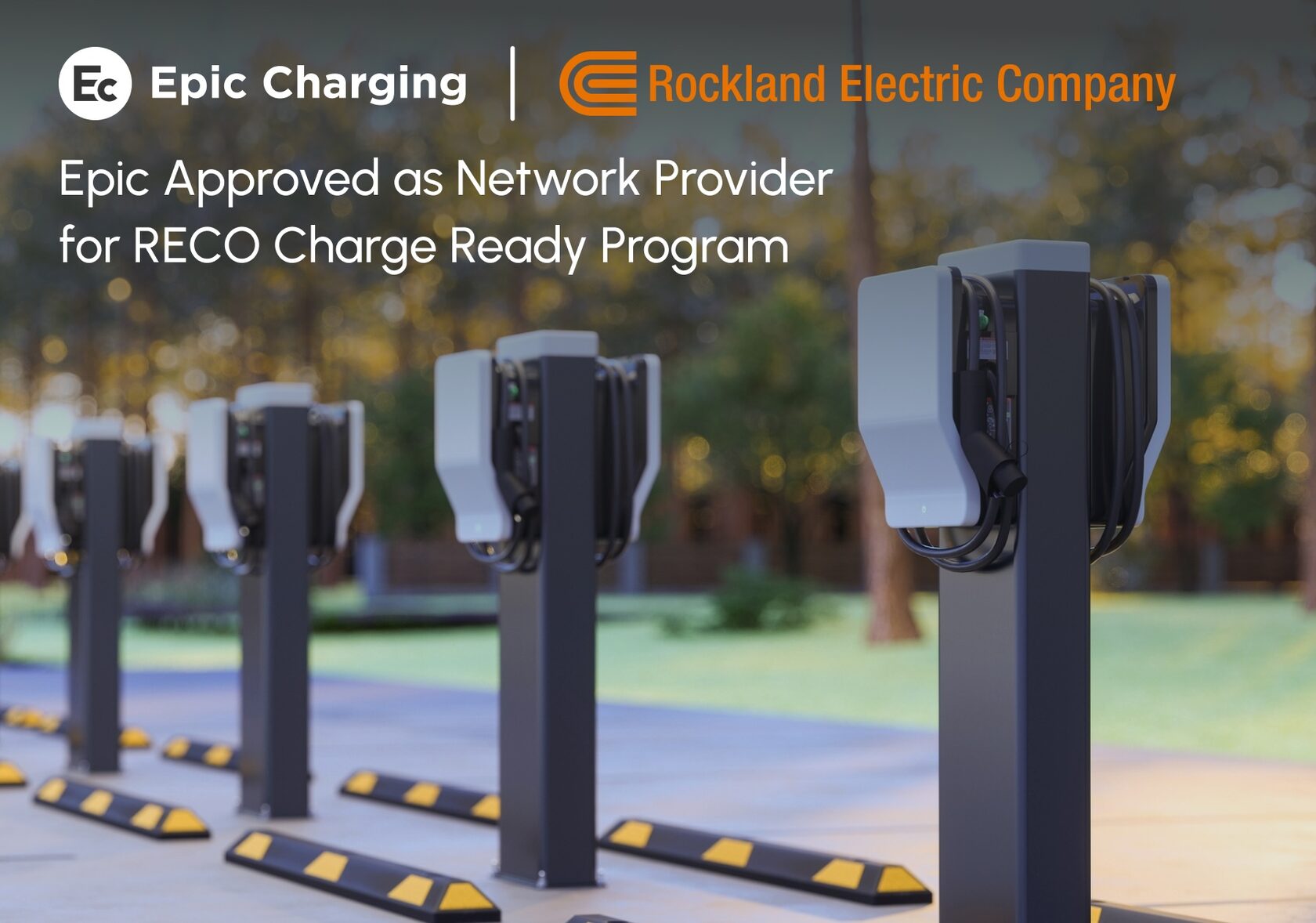
Rockland Electric Company (RECO), a subsidiary of Con Ed-owned Orange & Rockland Utilities, demonstrated its commitment to sustainable transportation when it sought and received approval for a portfolio of clean energy programs designed to reduce 280,000 tons of greenhouse gases while saving customers up to $70 million. Bold new incentives offered to commercial and residential customers include zero-interest financing and savings of up to 90% on all make-ready costs for Level 2 and DCFC chargers at businesses and multifamily properties. To help power the impending surge of new chargers, O&R then chose Epic as an approved network provider based on our track record of improving EV charging accessibility through an open protocol platform that maximizes uptime and prioritizes customer support.
Residential and Commercial Programs
The Residential and Commercial Charge Ready Programs were launched on December 19th, 2022 and run through December 18th, 2026, pending funding availability. Incentives are doled out on a first-come, first-served basis, and amounts are tiered subject to factors like whether the chargers are publicly accessible and if they are located in low-to-moderate income communities. Level 2 installations qualify for a maximum per-plug incentive of $4,400 on the utility side and $9,200 on the customer side while DCFC installations can receive up to $2,000 per plug on the utility side and $81,000 per plug on the customer side. A report filed in March of 2025 with the New Jersey Board of Public Utilities (BPU) shows the program already supports 72 commercial Level 2 ports and 20 DCFC plugs (and counting).
Qualified Expenses and Requirements
Make-ready costs are eligible on both the utility side (that is any infrastructure located between the electrical distribution system and the meter) as well as the customer side (infrastructure like conduits and transformers located between the meter and the EV charge). Eligible plugs must be capable of charging at 50 kW or greater, and stations with more than 10 plugs and/or demand in excess of 2 MW will only receive approval if RECO’s costs are limited to the equivalent of a 2 MW site. Publicly accessible chargers must be listed on the DOE’s Alternative Fueling Station Locator and customers must agree to share advanced metering infrastructure (AMI) data with RECO. Equipment or labor related to the EV charger itself, the pedestal, maintenance or software costs do not qualify.
DCFC Incentive Programs
RECO offers an additional incentive meant to stimulate DCFC deployment through decreased operating costs, whereby customers can offset up to 75% of their demand charges on standard DCFC plugs connected to a smart meter with AMI data-sharing enabled. Customers must either take service under a demand-based tariff, which encourages less electricity usage during peak times when the grid is under the most pressure, or under a BGS-CIEP (Basic Generation Service – Commercial & Industrial Energy Pricing) tariff, which requires participants to use energy supplied by RECO rather than a third party. The former caps out at $5,400 for years one and two, then $3,600 for years three and four, while the latter is capped at $12,600 each year for the first two years.
Fleet Assistance
Local schools, state commissions, state boards and agencies, municipal commissions, county governments, state universities and community colleges that are interested in converting their fleets to plug-in electric qualify for assistance through BPU’s Clean Fleet Electric Vehicle Incentive Program. Medium- and heavy-duty fleet owners can qualify for $4,000 grants toward the purchase of BEVs and fleet-specific Level 2 charging stations, and $5,000 grants toward public Level 2 chargers. RECO provides support by conducting an assessment of the installation request to confirm capacity and determine potential system upgrade costs.
How to Apply
Applicants for the Residential and Commercial Charge Ready Programs can submit an application through RECO’s online portal. Required supporting documentation during the application process includes proof of a valid RECO account number at the installation address and a paid installation invoice from a certified electrical company on their letterhead. For the DCFC Incentive and Fleet Assistance Programs, applicants can enroll by emailing chargerready@oru.com.
Epic Charging’s Role
RECO customers that install chargers can utilize our revolutionary charge point management system (CPMS), boasting one of the highest ratings of any EV charging app and an Electric Power Research Institute (EPRI) certification awarded for industry-best standards in quality, security and performance. Our network employs an open charge point protocol (OCPP) that allows for interoperability with nearly any charger brand on the market, enabling enhanced remote management capabilities and easy integration with grid services while virtually eliminating vendor lock-in. Our servers are US-based and SOC 2 compliant to ensure maximum data protection, our ability to migrate chargers at scale is unmatched, and our customer care team is available 24/7 to troubleshoot issues and limit charger downtime. Moreover, we help site hosts maximize the benefits of rebate programs like RECO’s while minimizing strain on the electrical grid.
The Bottom Line
RECO offers its customers a chance to go green while saving some green, with 70% of all reduced energy costs going directly into customers’ pockets. This combined with Epic as an approved network provider means Garden State residents and business owners enjoy some of the most generous financial incentives available today while also having access to the most robust CPMS on the market – one that operates seamlessly with RECO’s programs and services.
Contact us today for a free consultation on RECO’s various incentive programs, including assistance with project planning and enrollment.