
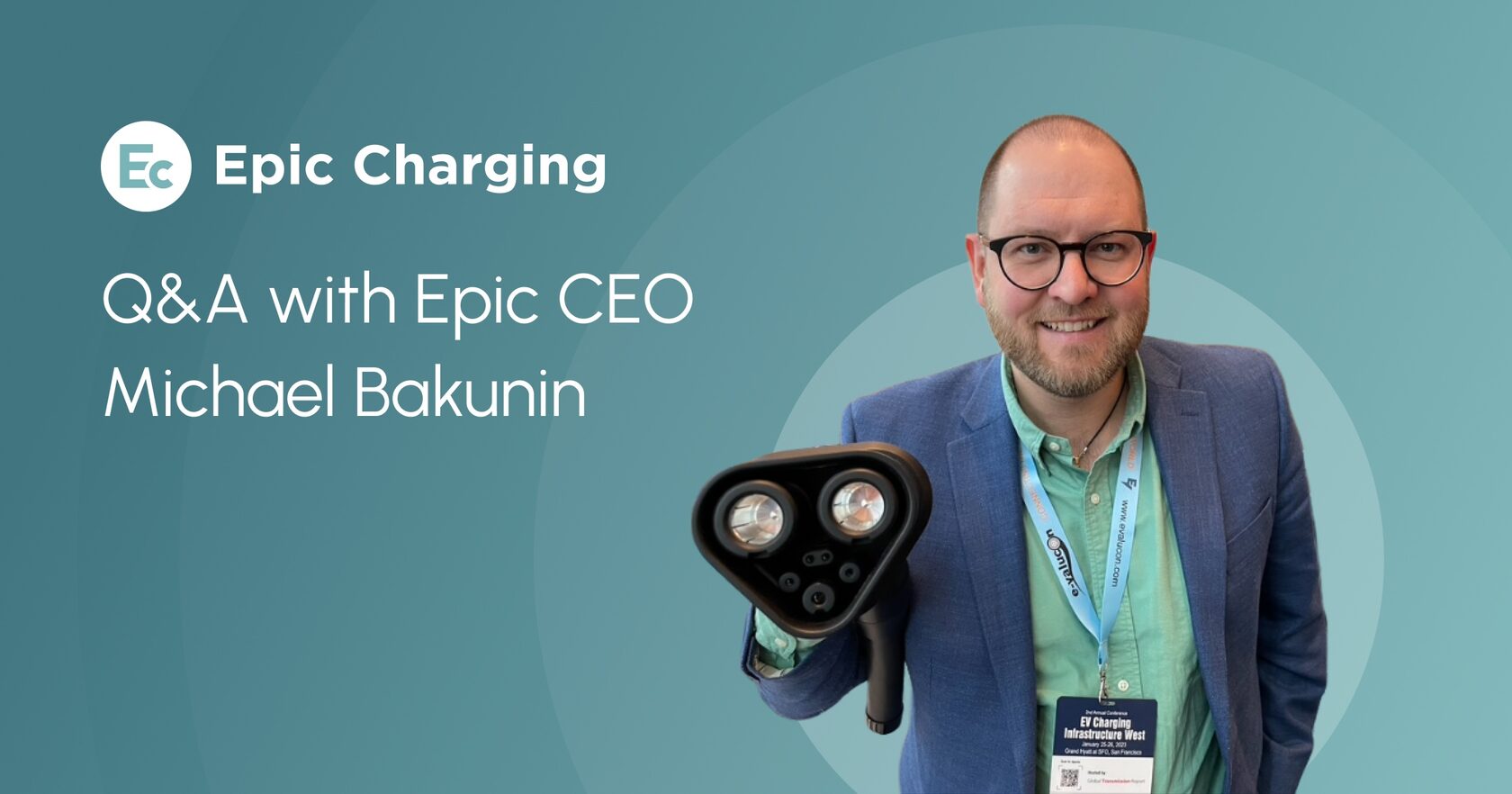
Epic Charging has emerged as one of the leading EV charging software providers in the US over the last two years, proving its customer-focused, open protocol platform is resonating with site hosts. The company’s vision is being spearheaded by co-founder and CEO Michael Bakunin, who has spent the last decade pursuing electric mobility solutions across three continents, including prior stints with the Renault-Nissan Alliance. We recently sat down with Michael to get his perspective on what’s driving Epic’s success.
Ohm Analytics recently named Epic the fastest-growing EV charging platform, with the number of ports using Epic’s CPMS increasing 2,342% since January of 2024. What’s fueling this growth?
Epic Charging was actually founded four years ago, but in the past 12 months, we've grown exponentially. And the reason is really two-fold. First, the market is evolving, and companies that are not able to be competitive are exiting. One of them was a utility company, Enel, from Italy, which had a huge install base in the United States. When they exited, they stranded roughly 200,000 EV drivers without access to charging. So that opened up a huge opportunity for us. We were the only US-based company that was able to translate Enel’s closed protocol system into open protocol and manage the charging stations. That has been one key pillar of our growth. And the second was our ability to seize on an exciting new partnership. We were selected as an exclusive technology provider for LAZ Parking, the top parking operator in the country, and together we announced our plan to deploy 50,000 Level 2 charging stations across the US and Canada. So that fueled our growth as well.
What are some of the biggest differentiators between Epic’s platform and that of rival providers?
The main problems right now in the EV charging world are charger reliability and uptime. It's not enough just to install the charging station; it needs to work. And how do you solve these problems? You need to work with people who really know what they're doing. We have the tools and capabilities to troubleshoot and resolve issues. We’re cybersecurity compliant with SOC2 certification. We have partnerships in place with utility companies, we employ OpenADR and our servers are US-based. And we integrate with ticketing systems such as Zendesk and HubSpot, which is unique to the industry. In some cases, we even integrate with ChargerHelp, which doesn’t just monitor the stations, but performs proactive maintenance and dispatches technicians.

Epic has focused much of its energy in the multifamily space, including, most recently, completing one of the nation’s largest residential installations to date at a 401-unit condominium complex in Chicago. Why is multifamily so important to Epic?
Our partner, LAZ Parking, often says you need to charge where you park, which is not only convenient, but it's your idle time. You use your car maybe 5% of the time, and the other 95%, it’s parked. So this underscores the importance of multifamily properties, parking garages, things like that. Multifamily is both the largest segment in the charging world and the fastest growing. In the past, it has been more or less an amenity for tenants. You know, a “nice to have.” But I think the real estate market is changing right now. First of all, it's harder to attract new tenants if you don't have charging infrastructure in place because a lot of people are owning or leasing electric vehicles. Second, the value of your property increases if you can offer charging infrastructure, and it also provides an additional revenue stream. So yeah, we believe it's the future of charging.
Many multifamily property owners and fleet operators have expressed frustration with their current providers, but don’t know what to do about it. How might Epic be able to help them?
When electrification started gaining ground like five, 10 years ago, there were really just a handful of companies that offered charging solutions. And because the competition was light, terms were really aggressive. Even draconian. Companies would not just require you to pay high fees for the hardware installation, maintenance and software, but also a large revenue share. In fact, some would require you to pay 50% of your charging revenue just to ensure your stations were up and running. But now, there’s a lot more competition in the market. If the contract with your software provider is up for renewal, you can reassess it. If you're paying 50%, you can question it. You can go out there and request quotes from companies like Epic, and we’ll be a lot more competitive. We definitely won’t ask you to pay 50% of your revenue.
How do you see the future of EV charging taking shape, and what will be Epic’s role in shaping that future?
Electrification is irreversible. I think we passed the tipping point around 2021. Now, in 2025, it's business as usual. Even though the new administration changed certain policies, we still deploy hundreds of thousands of charging stations every year. And this number is growing. Plus, the number of EVs being manufactured and sold every year is in the millions. So this is our everyday reality. But what we're also observing is a growing gap between the number of EVs and the number of public chargers available to EV drivers. In other words, EV manufacturers are doing a much better job than the infrastructure community. In Europe and Asia, the gap is smaller, so we have a lot of work to do here in the United States to catch up.

Put bluntly, our goal is to be a leading EV charging software provider globally. And our growth rate over the last 12 months proves we’re on track. So we'll continue that trend by maintaining a very high level of service and support, which is a core pillar of our business.
Click here to learn more about what Epic Charging is doing to accelerate the world’s transition to sustainable transportation.
Click here to learn more about what Epic Charging is doing to accelerate the world’s transition to sustainable transportation.