
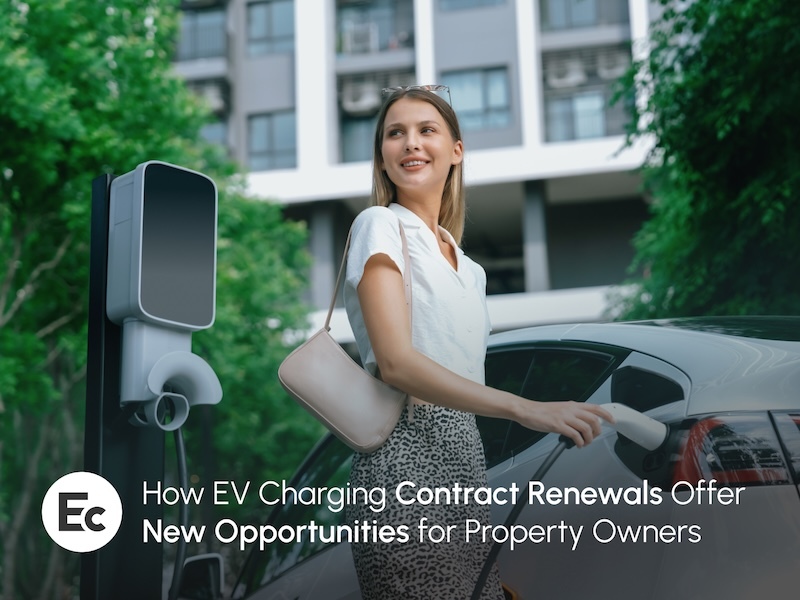
Early adopters of EV charging technology in the multifamily and commercial property space saw an opportunity to capitalize on a win-win proposition: an eco-friendly amenity that would attract loyal tenants concerned with sustainability while simultaneously increasing property values and boosting revenues. For most, the gamble worked. A 2022 survey by the National Multifamily Housing Council found that 27% of renters indicated they would pay an average of $28.12 more per month for properties that had EV chargers. Moreover, the US Department of Energy found that residential buildings with EV chargers can sell for up to 3% more than those without them while commercial buildings can sell for up to 10% more. However, the downside was that many of these early provider contracts came with draconian terms that limited choice and stifled growth.
Early Contracts Issues
As far back as the 2010s, owners of commercial real estate and multifamily properties found themselves locked into five-, seven- or even 10-year exclusive contracts with EV charging service providers, most of which offered very limited conditions for early termination. Providers also demanded expensive license fees and heavy revenue-sharing deals as a way to offset the appreciable risk of scaling this new, unproven technology. And despite the cost, software was inflexible, hard to scale and lacked any legitimate customization capabilities. Unfortunately, this model was pervasive throughout the industry, making alternatives equally limited, and so property owners who wished to capitalize on the benefits were forced to swallow the drawbacks. Since then, many owners have robotically signed contract renewals with these providers because they’ve become complacent, aren’t aware of new alternatives or, worst of all, are unwitting victims of vendor lock-in.
Changes in the Market
The last decade has brought a number of notable changes to the world of EV charging. In 2014, the Open Charge Alliance (OCA) was formed to advance open standards in sustainable charging solutions, leading to industry-disrupting innovations the following year like smart-charging support and the adoption of JSON (a data exchange format praised for its simplicity). In 2018, Open Charge Point Protocol (OCPP) 2.0 debuted with security, monitoring and management features far more advanced than early 1.0 versions, helping open protocol software achieve market dominance. By 2024, the International Electrotechnical Commission (IEC) approved OCPP 2.0.1 as the international standard for EV charging software. These changes combined with growing public support for EVs served as risk barriers, opening up the market to transformative new providers like Epic that could offer sites hosts more flexible solutions at lower costs.
Early Contracts Issues
As far back as the 2010s, owners of commercial real estate and multifamily properties found themselves locked into five-, seven- or even 10-year exclusive contracts with EV charging service providers, most of which offered very limited conditions for early termination. Providers also demanded expensive license fees and heavy revenue-sharing deals as a way to offset the appreciable risk of scaling this new, unproven technology. And despite the cost, software was inflexible, hard to scale and lacked any legitimate customization capabilities. Unfortunately, this model was pervasive throughout the industry, making alternatives equally limited, and so property owners who wished to capitalize on the benefits were forced to swallow the drawbacks. Since then, many owners have robotically signed contract renewals with these providers because they’ve become complacent, aren’t aware of new alternatives or, worst of all, are unwitting victims of vendor lock-in.
Changes in the Market
The last decade has brought a number of notable changes to the world of EV charging. In 2014, the Open Charge Alliance (OCA) was formed to advance open standards in sustainable charging solutions, leading to industry-disrupting innovations the following year like smart-charging support and the adoption of JSON (a data exchange format praised for its simplicity). In 2018, Open Charge Point Protocol (OCPP) 2.0 debuted with security, monitoring and management features far more advanced than early 1.0 versions, helping open protocol software achieve market dominance. By 2024, the International Electrotechnical Commission (IEC) approved OCPP 2.0.1 as the international standard for EV charging software. These changes combined with growing public support for EVs served as risk barriers, opening up the market to transformative new providers like Epic that could offer sites hosts more flexible solutions at lower costs.
Opportunities at Renewal
Many multifamily and commercial property owners are approaching contract renewal time, which offers them a critical opportunity to reevaluate their needs and assess whether their current providers are meeting them. Such properties typically require software that can scale across hundreds of charging stations while being centrally monitored, managed and maintained in order to maximize both revenues and uptime. According to Canary Media, unreliable charging infrastructure and uptime information are two of the biggest pain points for site hosts, with many unsure how to fix it. Fortunately, hosts who already invested in OCPP-powered chargers have put themselves in the enviable position of easily switching to new providers who are more reliable, less restrictive and more cost-effective, while those locked into proprietary software systems are faced with fewer prospects and higher migration costs.
Why Epic Charging?
Some may ask why we’re the clear choice for commercial and multifamily property owners looking to migrate to a new EV charging software provider. Reasons abound. First, we embraced the ideas of open protocol, 24/7 customer support and hassle-free migrations from the start, making them the cornerstone of our business and pioneering bold new innovations that vastly improved the hosting experience while driving down costs. Second, we’re based in the US, giving us a competitive technological advantage as well as server and IP protections that are second to none.
Third, unlike many others, we have a proven ability to migrate chargers at scale, even if they’re not currently OCPP-compliant, like we did with more than 3,000 JuiceBox EV chargers in 2024 when Enel X Way spontaneously shuttered North American operations. In fact, if chargers are not OCPP-compliant, we can offer a cost-effective rip-and-replace solution, and in some instances, programs like California’s Communities in Charge (of which we’re an approved vendor) will even fund such solutions.
We’re also certified by the California Type Evaluation Program (CTEP) as an accurate and transparent operator in the state; we achieved SOC 2 compliance by demonstrating the highest standards in data handling and security; we were qualified by the Electric Power Research Institute (EPRI) for meeting the power industry's rigorous criteria for safety, quality and performance; and we’ve facilitated numerous partnerships with utility companies across the country to minimize grid strain while maximizing incentives.
The Bottom Line
Contract renewals are a chance for multifamily and commercial property owners to reassess whether their EV charging software providers are giving them the level of service, support and control they need as their businesses grow. Epic offers a clear alternative for hosts who have historically been trapped in long-term contracts with little to no flexibility. Our OCPP-compliant platform is competitively priced, works with nearly any charger on the market today, can be migrated at scale and boasts best-in-class support to ensure trouble-free hosting.
Got a contract renewal coming up? Contact us first to see how we do EV charging better.
Originally published on MHN